
If you have been given a very long string of characters that start with vless:// and told to paste into an app then you are likely to have used V2Ray. In extremely censorship enabled networks V2Ray codes are often shared via Telegram, group chats and GitHub on a daily basis. Often these users have no idea what they are using or what the hosting server can see.
What is V2Ray?
V2Ray was initially released as a collection of networking tools for establishing private routes across the internet. This was known as Project V. V2Fly, the community maintaining V2Ray, describes it as a tool for establishing proxies to bypass network censorship. V2Ray is free and open source under the MIT licence.
V2Ray by itself is not very useful. You need a V2Ray server, and a client on either a phone or computer which can connect to this server. There are several such clients including v2rayNG for Android, v2rayN for Windows and Hiddify for all platforms. There is also the newer project Xray which was based on a fork of V2Ray but is now also used in many clients and servers.
V2Ray's advantage over a traditional proxy lies in obfuscation. It supports various protocols which can make the user’s traffic look like normal internet usage making it harder for a firewall to recognise and block.
What is a V2Ray config?
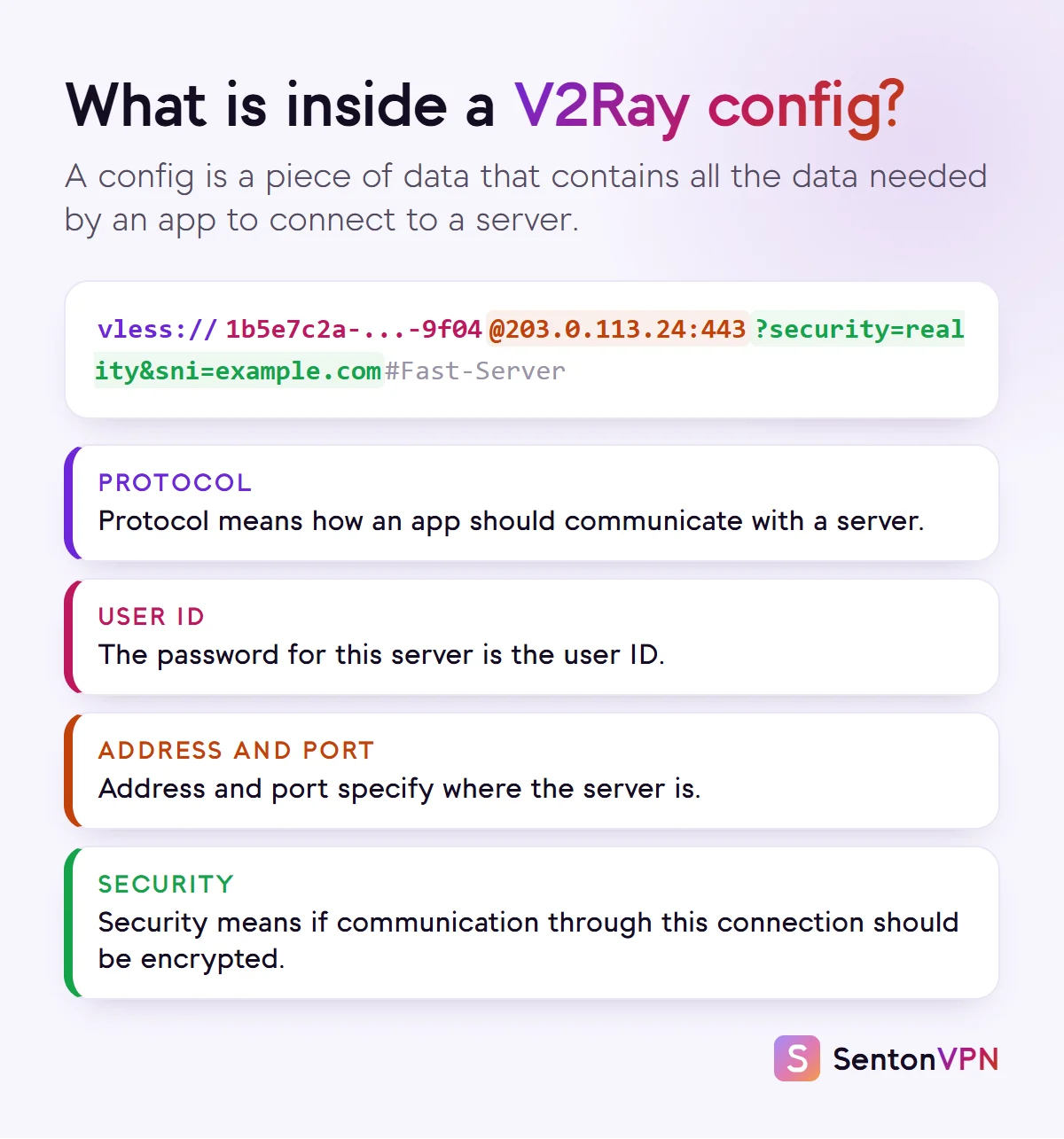
A config is all the data required for a client to connect to one server. This information is compressed into a single line. A typical config starts with the protocol such as trojan://, vmess:// or vless:// and is then followed by user ID, server address and server port. Then there are a series of options. These options affect the level of encryption used to communicate with the server and the method of obfuscation used.
A subscription link is a URL which contains all the configs. Clients can use these to automatically update their configs. The free lists shared by users are usually subscription links that contain thousands or hundreds of servers.
V2Ray vs a VPN: what is the difference?
They appear to do the same thing. Both route your traffic through a server located somewhere else. However V2Ray and VPN are not the same thing.
With a VPN there are servers hosted and run by the VPN company. You install an app, log in and then connect. All that the app does uses this connection.
V2Ray is a utility. The main purpose for it is to bypass blocking. There are a number of important features that are determined by the person creating the config. For example things such as duration of server, server, encryption and operator will vary depending on this person.
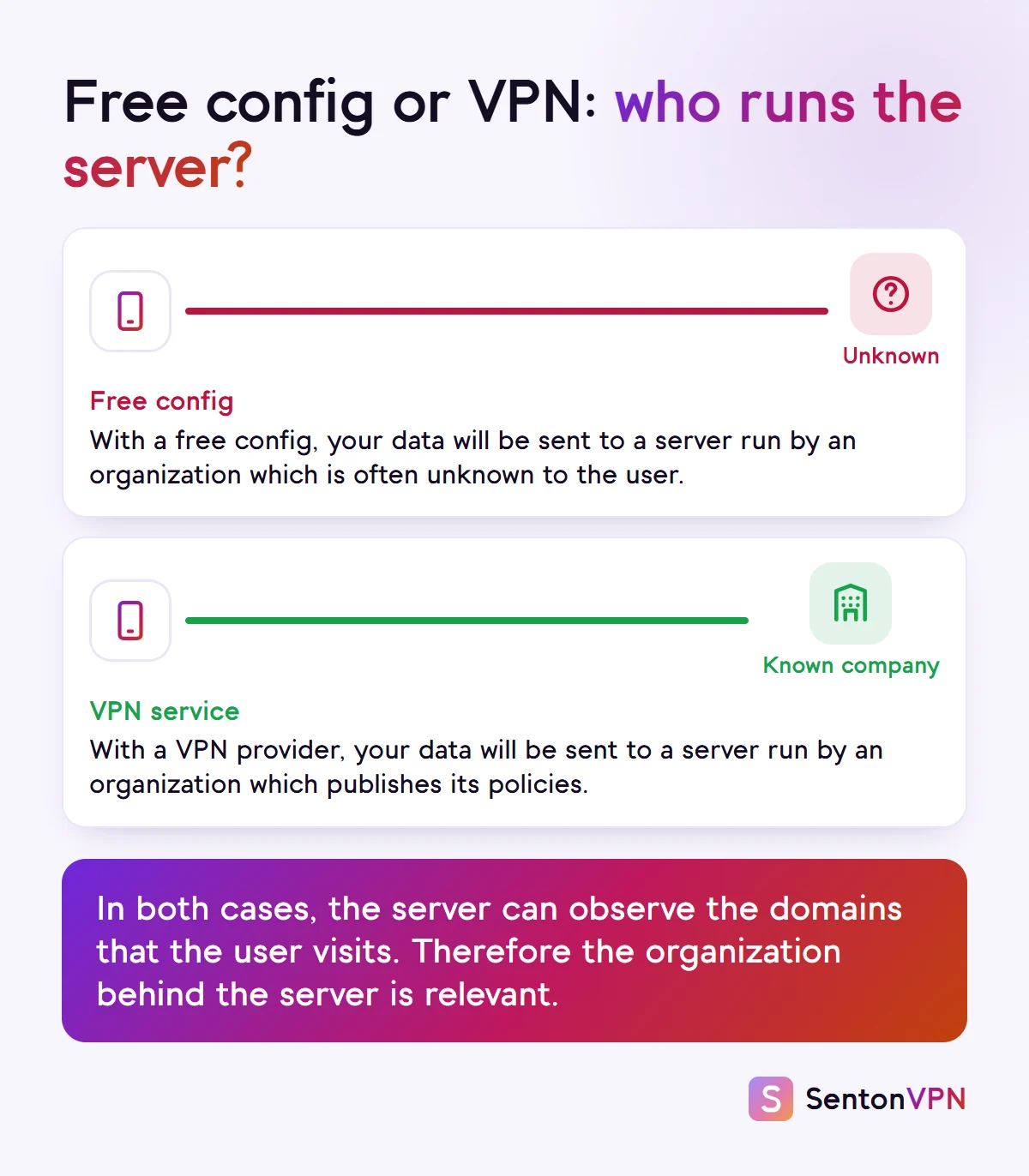
- Server operator. With a VPN this will normally be a company that can be identified. With a free config this will most likely be unknown.
- Main use. With a VPN the main use is privacy for the connection. With V2Ray the main use is bypassing blocking.
- Encryption. With a VPN encryption is provided by default. With V2Ray encryption will depend on the config provided and some may not even provide any encryption.
- Installation. With a VPN you install an app and log in. With V2Ray you need an app and a config from someone.
- Duration. With a paid VPN it will continue to work as long as you continue to pay for the service. With a free config it may stop working in hours or days.
- Coverage. A VPN app will tend to provide coverage for the whole device. A V2Ray app can provide full coverage for the whole device or just some apps depending on the config.
VLESS, VMess, Trojan, REALITY and Hiddify explained
There are five of the most common configurations that exist. Of all the free configs that can be found in list the most popular is VLESS. This is a very lightweight configuration that transfers data but does not have encryption itself. This means that the security VLESS provides is the same as the security provided by either TLS or REALITY. VLESS has been deprecated within the V2Fly project however is still under development for the Xray project.
VMess is an older configuration. This is the original configuration used in V2Ray. VMess has encryption however it is also time sensitive. If the time on your mobile is far different to the server then the connection will fail.
Trojan operates over a normal HTTPS connection and from the outside world will appear to be a person visiting a normal website. REALITY uses a certificate from a legitimate existing website. This means that the server does not need a domain but it will appear to be visiting that website. Shadowsocks is the oldest of the configurations. It is a simple encrypted proxy.
Hiddify is often confused with the above however is neither a protocol nor a server. Hiddify is an application that is available across Linux, Windows, Mac, iPhone and Android. It supports many configurations including VMess, VLESS, WireGuard, Trojan, REALITY and more. Hiddify itself does not provide servers. You will need a config from another user. The security of the Hiddify app is only as secure as that server.
When it comes to identifying if someone is using Hiddify or V2Ray it is important to identify who provides the server.
We read 7,539 free V2Ray configs
On 22 October 2026 we downloaded two of the most used public free lists from GitHub. No servers were requested when loading the lists and both lists had server configs for the server they were connected to.
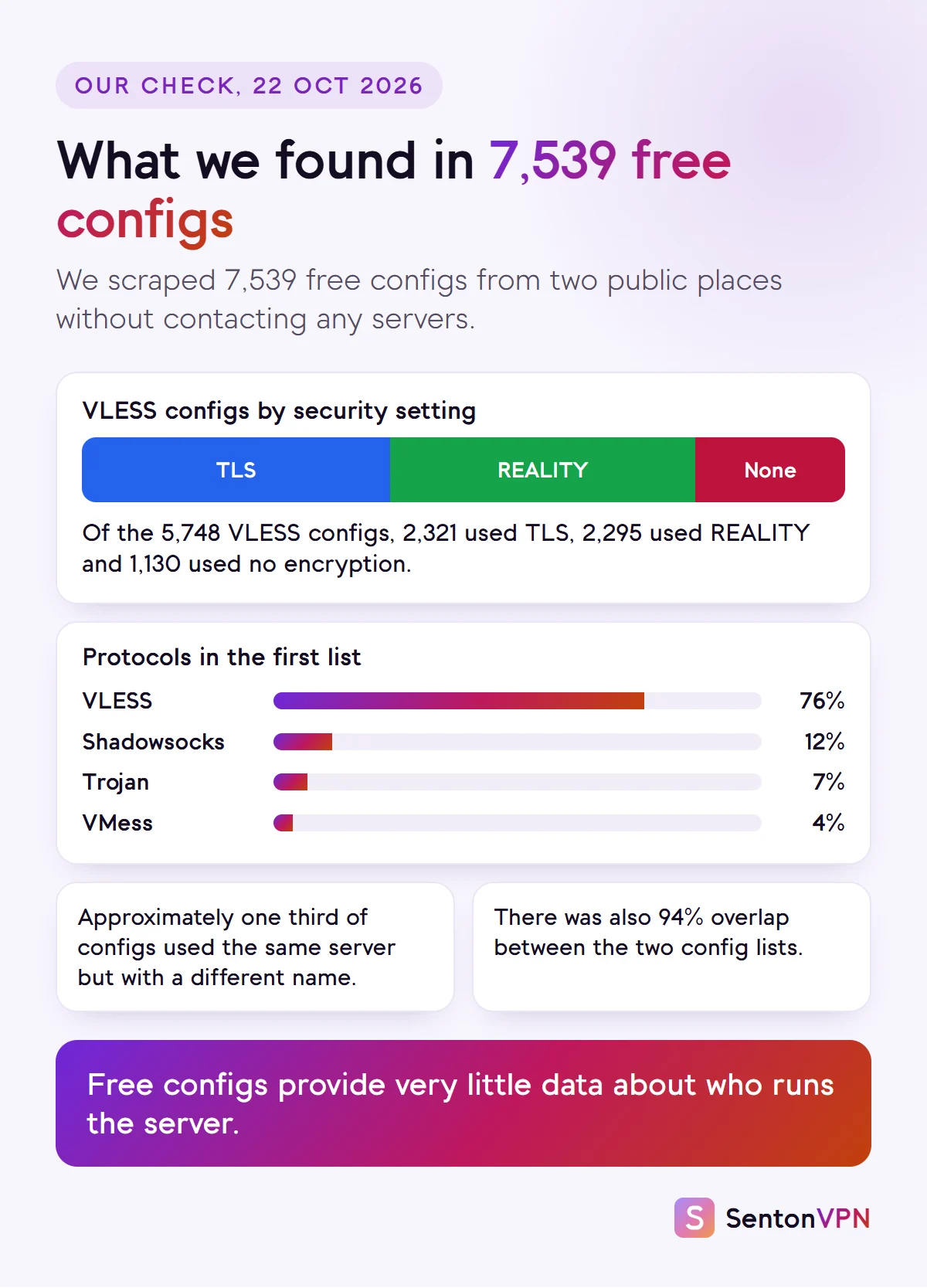
The first list had 7,539 configs and the second list 7,538. When we removed the display names from the first list we found 5,196 unique configs. Around a third of the configs were for the same server but with a different display name. The two lists shared roughly 94% of their configs. There is a significant amount of copying between free lists.
The most commonly used protocol in the first list was VLESS (76%) then Shadowsocks (12%), then Trojan (7%) and finally VMess (4%). Of the 5,748 VLESS configs 2,321 used TLS and 2,295 used REALITY. The remaining 1,130 VLESS configs did not have encryption between client and server as the security parameter was set to none. This means roughly 1 in 5 VLESS configs do not provide encryption between client and server. Thus any data that is not already encrypted via HTTPS can be read by an intermediary.
We then examined the servers used by the configs. Around 22% (1,686) used an IP hosted by either Fastly or Cloudflare. Both these companies host large networks in front of millions of sites. Using an IP from one of these lists does not provide information about who is hosting the server behind that IP. One Cloudflare IP was used by 306 different configs. 54 configs used the url of an internet speed test page as their server.
Are free V2Ray configs safe?
- 1.Traffic is seen by the serverEvery free configFree configs are run on some other person’s server. This person might be able to see domains you visit or any information that isn’t sent over HTTPS encrypted. You also likely don’t know this person.
- 2.Some configs don’t provide encryptionConfigs set to security=noneAround 1/5 (1,130 out of 5,748) of our VLESS configurations do not have encryption (security=none). This allows all traffic between your client and the server to be sent unencrypted by the config. An observer on the same wifi as either the server or you will be able to see the domains you visit but will not be able to view any data beyond the domain name, such as within an HTTPS page or a password on an HTTPS page.
- 3.Logging might take placeAny server you do not controlA free server might log all traffic it observes. There is no company or policy that can be held accountable and there is no assurance that no logging is taking place.
- 4.Malicious appsWhen you install an appWhen looking for a V2Ray app there might be malicious app versions or unofficial download pages. A malicious app can cause more problems than a config can. Only get apps from the official app stores or from the project release page.
- 5.Configs might failLists that refresh all the timeFree servers might get overloaded, blocked, shut down or otherwise constantly unavailable. This forces lists to be updated a few times per hour and users to pick up any new available configs. This complicates careful inspection further.
- 6.Payments, social media and email loginsEmail, banking and social mediaUsing an unknown server to log into email, social media, payments or other such services can put these services at a higher risk especially if the connection is not encrypted.

Why V2Ray searches spike in Iran and Turkmenistan
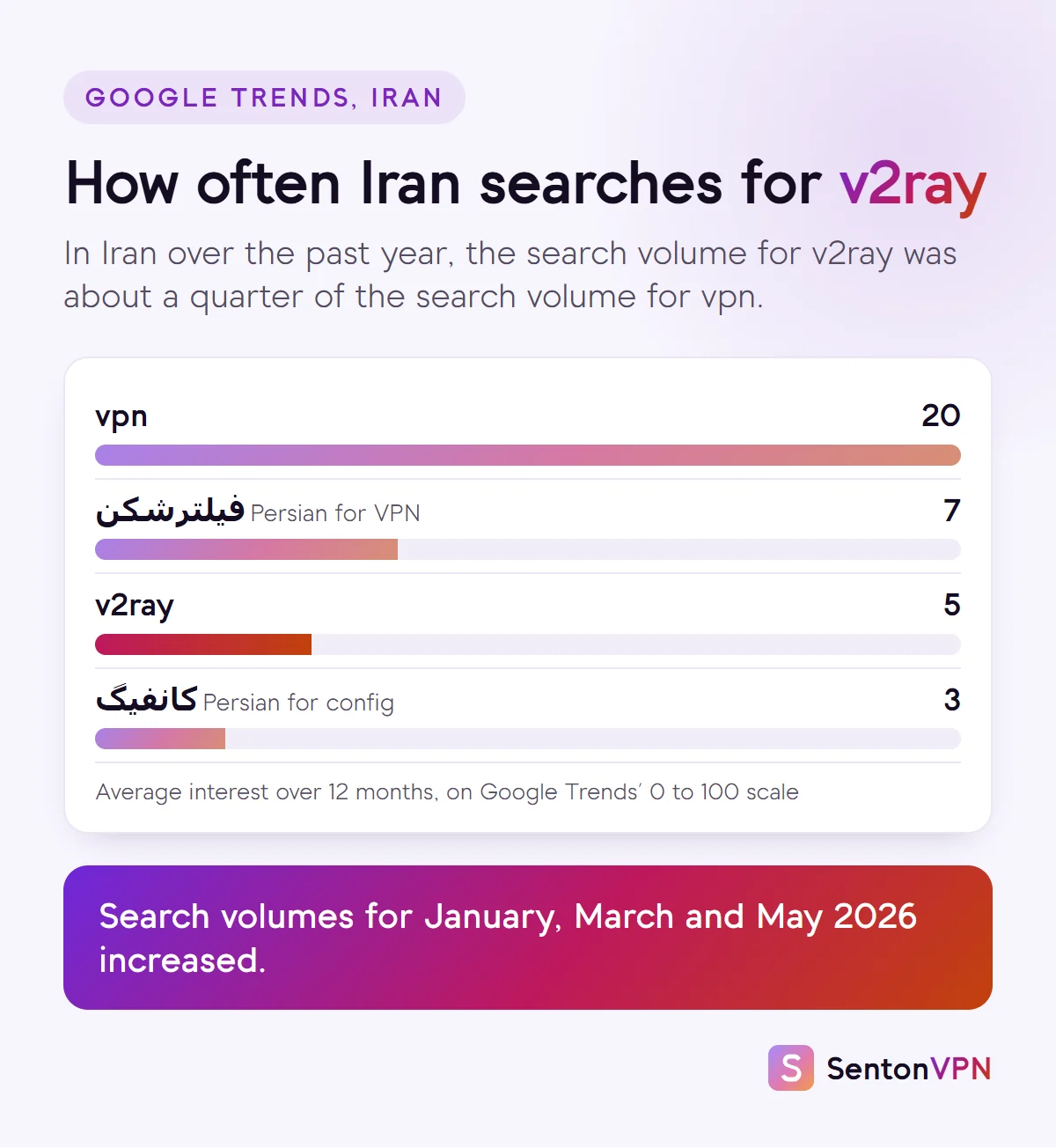
These tools clearly have some interest. Hiddify is being searched all over the world about 110,000 times per month. V2Ray is being searched about 90,000 times per month and VLESS about 40,000 times per month. Search rates go up during blackouts. In Iran Google Trends shows that searches for v2ray are about a quarter of the amount of searches for vpn over the past year. There are spikes in January, March and May 2026. In Turkmenistan there are searches for how to create a VPN code and for VPN codes in Turkmen.
How to use V2Ray configs more safely
After analysing 7,539 free codes we have decided to alter the usage of free codes.
 1Saravless://1b5e...@203.0.113.24From a friendStep 1Get codes only from people you knowThe first change is that we would not source codes from large public code repositories. If a family member or friend is running the server they can inform you of what is being logged. If someone is sending their message to forty thousand people they will not do so.
 2securityrealitysecuritynoneStep 2Check the security setting firstThe second change is that we would not use any code without reading the content after security=. Approximately 20% of our VLESS codes did not have any content after security=. This means there is no security on the link to the server. We would expect at the very least reality or tls.
 3https://example.comConnection is secureStep 3Keep passwords on HTTPS sitesPasswords would only be used for services that have the padlock. On HTTPS services the password is not viewed - only the URL of the service is visible to the server.
 4Installed fromGoogle PlayFile from a chatStep 4Install the app from official sourcesWe would only source the app from the official store or the project's GitHub page. We would be more worried about a malicious app being distributed via chat rather than an individual malicious code.
 5
 Senton VPNConnectedStep 5Use a VPN with a known owner for everyday useFor work, banking and all other parts of daily life we would not use free codes instead we would use a VPN from a provider that has an identifiable owner and a published no-logs policy. This gives us encryption from the outset and gives us someone to hold accountable for the servers.
How Senton helps
Senton provides a VPN rather than a V2Ray. We do not provide codes. We provide an app which, upon registration and login, will connect to our servers using an encrypted protocol called WireGuard. On Chrome it will encrypt within the Chrome application and on Android it will encrypt the entire Android phone or Android tablet. Safeweb will filter tracking and malicious domains. If the VPN connection is disconnected, supported traffic will be blocked by our Kill Switch to ensure that such traffic is not sent without a VPN connection. Please see our website for more information regarding our no-logs policy.
The bottom line
- V2Ray is a circumvention tool.
- Each configuration file will allow connection to one server.
- Free codes do work but they connect to a server with little to no information about that server.
- For regular use we suggest either REALITY or TLS codes, use HTTPS for individual accounts and connect via a VPN from a trusted provider.